Dashboard

Image
Hero Image
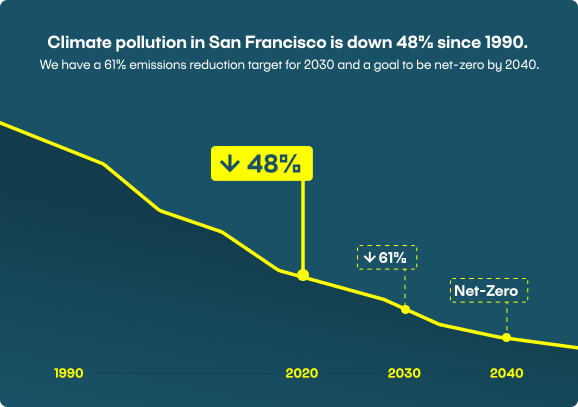
SF is making real progress against climate change.
This dashboard provides an easy way to track the city’s efforts toward achieving net-zero emissions by the year 2040.
Image
hero chart
This dashboard reports final progress on San Francisco's 2021 Climate Action Plan, including goals and actions across the seven sectors below. While this dashboard reflects the 2021 framework, the City has since adopted an updated plan.
See the latest Climate Action Plan

Climate Action Plan Sectors

The 2021 plan is organized into these key sectors.

Image
Energy Supply

Energy Supply

Image
Building Operations

Building Operations

Image
Transportation and Land Use

Transportation & Land Use

Image
Housing

Housing

Image
Responsible Production and Consumption

Responsible Production & Consumption

Image
Healthy Eco Systems

Healthy Ecosystems

Image
Water

Water Supply

Recent Achievements

Image
Building Operations
Building Operations
On Track

Eliminate fossil fuel use in existing buildings. (BO 2)

A new system was launched in 2025 to monitor replacement of private gas-fueled appliances with clean electric ones. Since 2020, San Francisco has increased heat pump HVAC system installation by 280%.

Image
Transportation and Land Use
On Track

Accelerate the adoption of zero-emissions vehicles (ZEVs) and other electric mobility options. (TLU 7)

In 2025, San Francisco’s first public fast-charging plaza opened, in the Bayview-Hunters Point neighborhood. The charging station is open 24/7 and can get cars to a full charge in just half an hour.

Image
Healthy Ecosystems logo
Healthy Ecosystems
On Track

Restore and enhance parks, natural lands, and large open spaces. (HE 3)

San Francisco expanded its natural areas, restoring dune habitat in its newest park, Sunset Dunes. (Image credit: SF Rec & Park)

Implementation Snapshot

The SF Climate Action Plan describes the actions the City and community can take together to tackle the climate crisis. These charts show progress on implementation.

Latest Indicators

An at-a-glance overview of the City's progress toward meeting the Climate Action Plan's goals across all seven sectors.

Image
Energy Supply

Energy Supply

Meeting the goals of this sector will include continued delivery of renewable electricity via Hetch Hetchy Power and CleanPowerSF, improved grid readiness and resilience, and the creation of local clean energy jobs.
Percent of electricity used in SF that is renewable
Strategy: Supply 100% renewable electricity to residents and businesses.
Read more
Annual spend on local distributed energy resources (DER) projects and customer programs
Strategy: Invest in local renewable energy projects and energy resilience projects.
Read more
Number of eligible customers on low-income electricity rate plans
Strategy: Supply 100% renewable electricity to residents and businesses.
Read more
Image
Building Operations

Building Operations

This sector’s actions aim to electrify new and existing buildings, provide targeted support for low-income renters and owners, and expand work opportunities for disadvantaged workers.
Image
Number of all-electric new construction exemptions granted in 2025 (0 - physical/technical infeasibility, 1 - commercial food service, 1 - EPCA exemption)
Number of exemptions granted for all-electric ordinance
Strategy: Eliminate fossil fuel use in new construction.
Read more
Number of households supported with electrification projects in Environmental Justice communities, by the Bay Area Regional Energy Network (BayREN)
Strategy: Eliminate fossil fuel use in existing buildings by tailoring solutions to different building ownership, systems, and use types.
Read more
Image
Transportation and Land Use

Transportation and Land Use

The focus of this sector is to shift trips away from cars and fossil fuel power toward more sustainable modes through infrastructure improvements, pricing mechanisms, smart land use, and electric vehicle adoption.
Muni average annual weekday ridership
Strategy: Build a fast and reliable transit system that will be everyone’s preferred way to get around.
Read more
Percent of on-street parking that is metered
Strategy: Manage parking resources more efficiently.
Read more
Number of housing units within a quarter mile of Rapid Network Lines*
Strategy: Promote job growth, housing, and other development along transit corridors.
Read more
Number of housing units within a quarter mile of commercial corridors*
Strategy: Strengthen and reconnect communities by increasing density, diversity of land uses, and location efficiency.
Read more
Percent of zero-emission vehicles (ZEV) out of new car sales in SF
Strategy: Where motor vehicle use or travel is necessary, accelerate the adoption of zero-emissions vehicles (ZEVs) and other electric mobility options.
Read more
Image
Housing

Housing

This sector aims to meet regional housing goals by accelerating the development of new affordable units and preservation projects, and ensure equitable access for Black, Indigenous and people of color (BIPOC) and vulnerable populations.
Total number of affordable and market-rate units produced
Strategy: Meet the needs of people and families with high housing cost burdens.
Read more
Number of affordable housing units preserved and rehabilitated each year
Strategy: Protect vulnerable populations through housing preservation and rehabilitation.
Read more
Image
Responsible Production and Consumption

Responsible Production and Consumption

This sector addresses embodied carbon in buildings and construction, lifecycle emissions from the consumption of goods and services, food system impacts, and air travel.
Tons of rescued building materials re-used
Strategy: Achieve total carbon balance across the buildings and infrastructure sectors.
Read more
Weight of food recovered through SB 1383 program enforcement
Strategy: Reduce the carbon footprint of the food system by reducing waste, promoting climate friendly diets, and getting excess food to communities in need.
Read more
Tons of trash disposed
Strategy: Promote reduction, reuse, repair, and recovery of goods and materials.
Read more
Image
Healthy Eco Systems

Healthy Ecosystems

This sector aims to protect and expand the use of natural systems –trees, parks, open spaces, and natural areas – to support carbon sequestration, biodiversity, and resilience.
Number of new trees planted and maintained
Strategy: Maximize trees throughout the public realm.
Read more
Image
Water

Water Supply

The focus of this sector is to continue conservation efforts, diversify water supplies, and improve the use of new water sources to address challenges brought on by climate change, drought, wildfires, and regulatory changes.
Number of innovative water projects in operation
Strategy: Invest and implement innovative programs to reduce water use and develop new water supplies.
Read more
Annual quantity of water reuse and recycling
Strategy: Invest and implement supply augmentation programs.
Read more